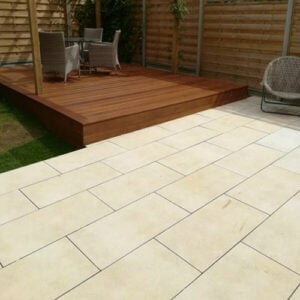
Porcelain Paving
The next big thing in outdoor paving, outdoor porcelain paving is changing the game. The main benefits come from the maintenance & longevity of porcelain paving, which is a primary concern for many people installing a new patio.Home / Paving / Driveway Paving / Porcelain
Product categories
Colour
Size
- 60cm x 60cm (1)
- 90cm x 60cm (19)
- 90cm x 60cm x 20mm (1)
- 100cm x 50cm (5)
- 120cm x 60cm (7)
- 122cm x 61cm (5)
- 40cm x 16cm x 10mm (12)
- 61cm x 61cm x 20mm (3)
- 80cm x 80cm (3)
- 90cm x 45cm (2)
- 90cm x 90cm (3)
Weight
- 16kg (12)
Volume
- Multi Slab Pack (48)
- Singular Slabs (48)
Edges
- Sawn Edges (48)
Shape
- Rectangular (45)
- Square (6)
Price
Porcelain Paving
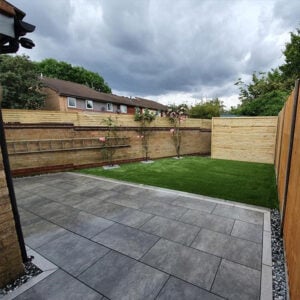
If you want to give your garden a stylish new look, a beautiful porcelain paving patio could be just what you have been searching for. Outdoor porcelain tiles may not be as well known as standard patio slabs or wooden decking, but they come with many fantastic benefits for your garden.
Porcelain paving slabs are made from a hardwearing, non-porous material which makes them low maintenance, easy to clean and very durable.
Frequently Asked Questions
Can you drive on porcelain paving?
Yes, with the right build underneath. Our porcelain slabs are 20mm thick, which is patio thickness, so they only take a car when every slab sits on a full, unbroken mortar bed over a properly compacted sub-base. Porcelain is extremely hard and strong in compression, but rigid: a slab bridging a void or a soft spot will crack under a wheel. Done properly it handles cars and light vans. For heavier vehicles or constant turning, block paving is better.
How much does a porcelain driveway cost?
Our porcelain starts from around £32 per m², with Kandla Grey, Cathedral, Mercury and Quartz 90 x 60cm slabs at £31.98. Larger formats run £38.99 to £53.99 per m². A 30m² driveway therefore costs around £960 for the slabs alone. Add 150mm of Type 1 sub-base at £98.99 per bulk bag, around 11 to 12 bags for that area, plus mortar, primer, jointing and delivery (charged by pallet and postcode).Â
Are 20mm porcelain slabs thick enough for a driveway?
Yes for cars, provided the bedding is right. 20mm is the standard outdoor porcelain thickness and it is what we stock; we do not carry a thicker driveway-grade slab. The strength comes from the slab being fully supported, not from its thickness, so the mortar bed must be continuous with no hollows. Where 20mm struggles is point loading: a delivery lorry, a skip, trailer jockey wheels or car jacks can all crack a slab. Keep those off a porcelain drive.Â
What sub-base does a porcelain driveway need?
Allow 150mm of compacted Type 1 under a porcelain driveway, against around 100mm for a patio. Excavate to roughly 250mm below finished level, lay the Type 1 limestone in two layers and compact each with a plate compactor, then bed the slabs on 40 to 50mm of mortar.Â
Will oil and tyre marks stain a porcelain driveway?
No, porcelain will not stain. It absorbs almost no water, so engine oil, brake fluid, petrol and rubber scuffing sit on the surface rather than soaking in, and wash off with hot water and a degreaser or a pressure washer. This is the strongest reason to choose porcelain over natural stone for a drive, as oil drips mark sandstone and limestone permanently without quick treatment. Porcelain also never needs sealing, so there is no coating to be damaged by fuel spills.Â
What jointing should I use on a porcelain driveway?
A brush-in compound such as our Joint-It Simple is suitable for driveways, and a 20kg tub covers around 12 to 15m². The important part is filling every joint to its full depth, because a partly filled joint lets a tyre load work the slab edge and chip it. Turning wheels put far more sideways force on joints than footfall does. Keep joints at least 5mm wide on a drive rather than the tight 3mm some patios use, and check them each year.Â
Is a porcelain driveway cheaper than block paving?
No, porcelain usually costs more. Concrete block paving is generally cheaper per m² than our porcelain, which starts at £31.98, and blocks are purpose-made for vehicle loads so they are quicker and less exacting to lay, with no primer and no full mortar bed. Porcelain buys you a flat, large-format surface that never fades, stains or needs sealing, and that matches a patio of the same slab.Â
Can porcelain be laid over an existing concrete or tarmac driveway?
Over sound concrete, yes. If the slab is solid, free of cracks and movement and falls away from the house, porcelain can be laid directly onto it using an external tile adhesive rather than a sand and cement bed. Check the finished height still clears your damp proof course and door thresholds. Tarmac is different: it flexes and softens in heat, so slabs laid on it will crack or lift. Tarmac must be dug out and replaced with a proper Type 1 sub-base.Â
Get the latest news & offers