Cut and Fill Excavation
Cut and Fill Excavation is the process of constructing a railway, road or canal whereby the amount of material from cuts roughly matches the amount of fill needed to make nearby embankments, thus minimising the need for additional labour.


Cut and Fill Excavation
In construction terms, excavation is the process of removing earth to form a cavity in the ground.
Excavation can be done in a variety of different forms, including Topsoil, Trench, Basement excavations and so on, but one of the more common is Cut and Fill excavation.
The Mick George Group has a wealth of experience which dates back over 40-years in completing all types of excavation works, varying in complexity and scale.
What is Cut and Fill Excavation?
In excavation, cut and fill is the process of constructing a railway, road or canal whereby the amount of material from cuts roughly matches the amount of fill needed to make nearby embankments, elevations or level surfaces, so minimising the amount of construction labour.
When creating an optimal terrain, various sections of the design will require bringing in additional earth, whereas other sections will require earth to be removed. The earth that is removed is referred to as Cut and the additional earth brought in, is referred to as Fill, hence Cut and Fill.

Cut and Fill Excavation Process
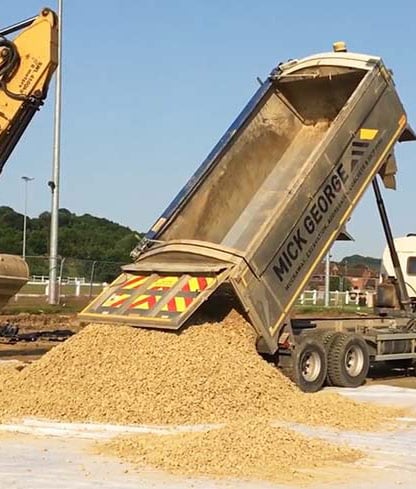
This process is usually accomplished with earthmoving equipment. Bulldozers and excavators remove land from cut locations and transfer it to dump trucks, which carry it to fill locations before compacting with a roll-style or plate compactor. This compacting process removes air before any construction takes place. It’s essential, as it prevents the earth from moving and settling during or after the construction process, which can damage the foundation and building features.


Calculating Cut and Fill
One of the simplest methods is the cross section method which involves plotting cross sections of the existing and proposed levels at regular intervals across the project site. For each of the cross sections, the cut area and the fill area is determined.
The volume between each pair of sections is estimated by multiplying the average cut or fill area of the two sections by the distance between them. Once these volumes have been calculated for each pair of sections, the total volumes are obtained by adding them all together.



Balfour Beatty
Earthworks Testimonial
The Mick George Group are carrying out works to an excellent standard in terms of safety, quality and programme. The Team are continually collaborating well with the Balfour Beatty project team with on-site operations and exploring value engineering opportunities.

C3 Construction
Earthworks Testimonial
The Mick George Group are one of our preferred suppliers and it's down to their competitiveness, reliability, product knowledge and excellent customer services. We can always trust that works are completed efficiently and to the best standard.
Latest Earthworks & Construction News
-

Mineral Products Leading Sustainable Growth
A recent industry wide report has found that on average, everyone in the UK relies on around 5.8 tonnes of mineral products each and every year.
-

Cement industry reports 25% CO2 reduction
A new global report finds that the cement industry has reduced the CO2 intensity of cementitious products by 25% since 1990.
-

Demand for circularity in construction on the rise
A recent report asked 500 UK decision makers from the UK construction industry to share their views regarding sustainable material solutions.


Get the latest news & offers