Each quarter, organisations must compile and submit a Quarterly Results Log to Street Works UK (via email / portal) containing classification counts and lab results.
Background & Rationale
- Until now, utilities have classified excavated waste under two main regulatory routes: Unplanned works → RPS 298 / RPS 299 (or earlier RPS 211) and Planned works → WM3 / Technical Guidance on the Classification of Waste (WM3)
- RPS 298/299 were always intended as interim or “special case” routes to allow flexibility where pre-excavation sampling was impractical.
- From 1 October 2025, the Street Works UK Material Classification Protocol (SWUK) was made mandatory for qualifying works.
- The goal is to introduce a consistent, sector-appropriate, risk-based approach that works even for reactive/unplanned works, with clearer obligations, improved traceability, environmental assurance, and regulatory oversight.
The New Street Works UK Classification Process
Qualification
Work must qualify for the SWUK protocol (i.e. not all excavations will be eligible). Qualifying types include:
- Immediate Urgent
- Immediate Emergency
- Minor
- Standard
- Some Major works, only when the permit is required purely for traffic management (i.e. the work itself is < 10 days but location demands closure)
Desktop Risk Assessment
Before digging, a version-controlled desktop risk assessment must be completed. This uses standardised forms and draws upon historical data, geotechnical records, local contamination registers, previous lab results, and known site context.
Site Assessment
Once excavation begins, a site-based assessment is carried out using structured questionnaires/ forms (version controlled). Observations, material characteristics (e.g. colour, odour, staining, hydrocarbon sheen), context, depth, adjacent contamination risk and anomalies guide classification.
Based on this assessment, each excavated waste stream is classified as Green (non-hazardous) or Red (hazardous).
Material Segregation & Handling
As materials are excavated, they must be segregated — soils, asphalt, bituminous layers, and any suspected hazardous materials must be kept separate from the start and maintained separately through storage, transport and disposal.
Material Transfer & Disposal / Reuse
Once classification is determined, Green (non-hazardous) material can move under a Waste Transfer Note. Red (hazardous) material must move under a Waste Consignment Note (or equivalent hazardous waste controls).The receiving facilities must be permitted to accept the classification of waste.
The new protocol does not by itself determine whether some excavated materials can be reused (i.e. non-waste). That determination is separate, under a waste law and reuse assessment. The Street Work UK protocol’s classification applies only where the material is waste.
Reporting, Records & Oversight
Each quarter, organisations must compile and submit a Quarterly Results Log to Street Works UK (via email / portal) containing classification counts and lab results. That same data (including UKAS lab results) must be uploaded to Street Manager, so regulators and local authorities can access the record.
Performance is monitored; if accuracy falls below thresholds repeatedly, organisations may be required to increase testing or may lose authorisation to use the protocol and revert to full WM3.
All records, risk assessments, test results, transfer notes, forms etc. must be retained for auditability and regulatory compliance.
How Can Mick George Help?
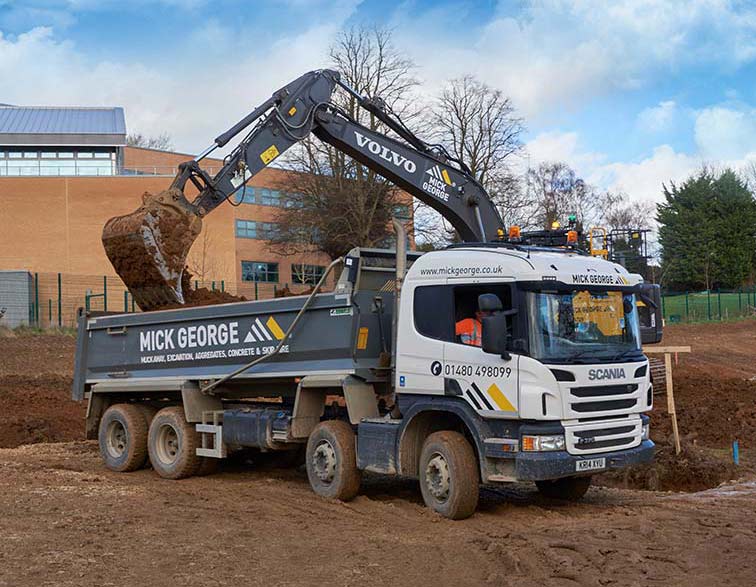
Working closely with the Environment Agency, the Mick George Group can assist with your tipping and muck away needs. Experienced in the Muck Away and Waste Management field for over 40-years, we have an extensive fleet of tippers, grab lorries and articulated vehicles to remove the hassle from any large volume waste removal.
Mick George Waste Management